wine-dark
A memoir — on Christopher Nolan's "The Odyssey," the rain, and the rowing
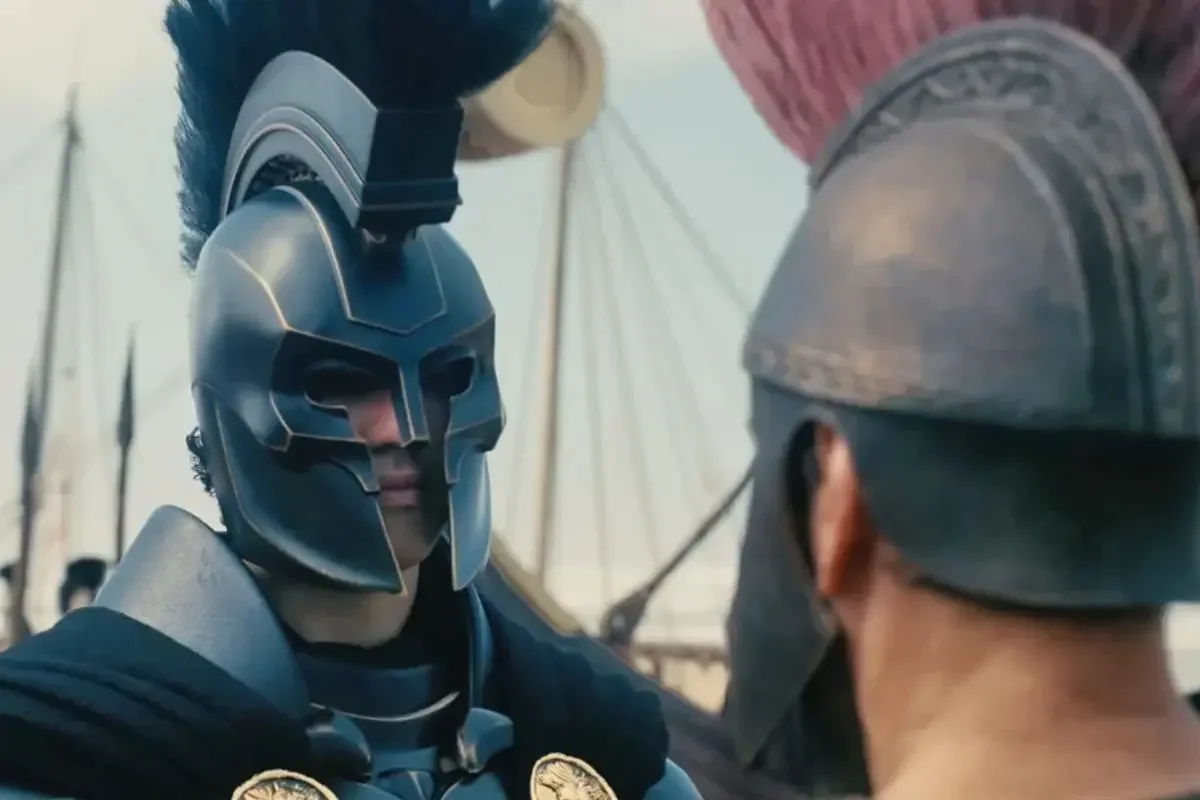
Agamemnon and Odysseus: two kings, eye to eye in the aftermath of a 10 year war
Somewhere in the third hour, four storeys tall in the dark, a man lashed to a mast was begging the men who loved him to let him go — and the men who loved him rowed on, and tied him tighter, over a sound I expect to be chasing for the rest of my life. I have carried that minute around all day, the way you carry a coal in a tin. But the evening started smaller than that. It started with rain.
Sydney doesn't drizzle in July; it commits. The rain came down Burwood Road in long grey ropes, gutter-deep and businesslike, and we ran the last block under one umbrella built for neither of us and arrived at the cinema laughing and half-drowned — which, for a film about the sea, felt less like bad luck than admission. Let me be upfront about the register of what follows, too. This is a love letter. I surrendered objectivity somewhere around the second trailer, and I have not missed it since.
The story we had come for is older than the alphabet. Before it was a film it was a voice — centuries of firelight, a poem that lived nowhere except the air between a singer and the people leaning in — and a cinema, whatever else it is, is that same room with better seats: strangers agreeing to sit together in the dark while one voice, made enormous, tells them about a man trying to get home. On a wet Friday in Burwood we joined a queue that has been forming for three thousand years. It was raining on it. We got in.
The lights went, and the first thing to touch us wasn't an image. Ludwig Göransson wrote the music — his third voyage with Nolan — and the stories from the production say Nolan forbade him an orchestra altogether, on the sensible grounds that no orchestra existed when this story was young. So Göransson went backwards. He built the score out of what Homer's first listeners might have died hearing — the aulos, a double-piped reed with a voice like a wasp in a temple; the lyre; gongs; scrap metal hammered into weather — and the result runs under the whole film like a keel. For three hours it did to that room what the sea does to ships. I want his name in this letter for that reason, and for a greater one I will come to.
The horse, when it arrived, I had been waiting for the way you wait for a famous chord — and when it stood there against the night I found I wasn't thinking about war at all. Walls are a technology for keeping out force, and nothing has ever been invented for keeping out a gift. Ten years of armies achieved precisely nothing against Troy; an invitation opened it in a night — a city hauling its own destruction through its own gates with garlands and songs, because the destruction had been beautifully made and looked like an offering. The genius of the horse was never carpentry. It was the discovery, the worst our species has managed, that trust is a wall's only unlockable door — that faith itself can be loaded and shipped. Something caught fire that night which has never since been put out. The city was rebuilt within a generation; the assumption never was. Civilisation runs on trust the way a lamp runs on oil — every market, every treaty, every stranger fed before he's asked his name — and Troy is the story of the night the oil was first deliberately poisoned. From then on the fire burns internally, in every city, forever. Each gift arrives trailing its invisible second cargo, the question; the horse stands in your inbox this morning wearing the livery of your bank; and every locked screen and fine-print instinct we own is smoke off that original blaze. The film understands, too, that its hero is the author. The man who poisoned trust for all mankind then serves ten years in the world the poisoning made — every island a possible trap, every host a possible knife, every kindness a possible hook. The sea is simply the invoice.
Running underneath everything, the whole night, was the other king. The film carries Agamemnon's story the way the poem carries it, and I won't say where it surfaces — spoiling a story this old still feels like a breach of hospitality — but the old material is brutal enough on its own. Agamemnon commanded the entire war. He took Troy. He sailed home in triumph, and he was dead almost at once — cut down in his own house, by his own household, in the one place on earth he had stopped watching. He survived ten years of spears and was killed by an afternoon of feeling safe. Victory, it turns out, holds no jurisdiction past a man's own front door; and his fate sits inside the Odyssey as the shadow-instruction the whole poem answers — the reason Odysseus enters his own kingdom dressed as a beggar, having learned from a dead colleague that home must be approached like enemy country, that the last siege of any war is the doorway, that the war does not end when the war ends but merely changes address. Sitting in the dark I stopped seeing kings at all and saw everyone who has ever come back from something — a war, a ward, a year that took the skin off them — and found the return was a second campaign nobody had briefed them for. You can survive the whole sea and drown in the hallway.
His armour, I should mention, is the film's little scandal. The internet had been cross about it for months — matte black, wrong century, wrong metallurgy, not a boar-tusk in sight — and the complaint has a point while missing a much larger one. In the theatre it looked magnificent: light-swallowing, funereal, a king dressed as the closing hour of his own age. And the Trojan War is not a documented campaign with a costume department available for audit. As far as anyone can actually prove, it is a story — and the story was already wearing borrowed clothes by the time Homer received it. The poem hands its heroes equipment from centuries apart; the famous boar-tusk helmet was an heirloom of a vanished era even to the poet describing it; three hundred years of retelling had folded whole generations of armour into one imaginary war long before anyone wrote a line of it down. There was never an accurate version to betray. Demanding period-correct armour from a myth is demanding accurate weather from a dream. The armour's job was never to match a museum case. Its job was to make a doomed king look like doom — and I stopped breathing when the doors opened, which I take as the costume doing its work.
And then the mast. I won't tell you how Nolan stages the Sirens — you deserve to meet the scene cold, as I did — but the ancient material beneath it deserves to be better known, because it is the most quietly devastating thing in the poem. The Sirens' song is not what the centuries have painted over it; the seduction we've been trained to expect is nowhere in the text. What they actually promise is knowledge. We know everything, they sing. We know all that was suffered on the plain of Troy. Come closer, and go home a wiser man. They are offering him his own story — his own war, his own decade of grief, sung back entire, with its meaning finally attached. The deadliest music in the universe turns out to be perfect comprehension of your own life, and the meadow at their feet is white with the bones of men who stopped rowing in order, at last, to make sense of themselves.
He doesn't stop his own ears. That detail is the hinge the whole scene turns on: the wax is for the crew — for himself he chooses the rope. Offered the off-switch, he declines it. He would rather hear the thing that kills men and be bound than pass it deaf and free; he means to be the one human who heard the entire song and lived, and the only route there is to arrange, in advance, in cold blood, for his own future self to be overruled. Tie me to the mast, he tells them, and whatever I say once the singing starts — if I beg, if I command you as your king — disobey me. Bind me tighter. It is the strangest definition of freedom I know and I suspect the truest: he is never freer than in the moment he cannot move. Wisdom here has nothing to do with willpower. Wisdom is precommitment — the humility to know that a stronger version of the song will one day meet a weaker version of you, and to send help backwards through time. The ropes are a letter to his future self, written by the only man who could be trusted to write it and could never be trusted to read it.
Then there is the crew, and the scene quietly stops being about him. They hear nothing — their ears stopped with wax he softened himself — and they row through the most beautiful sound in the cosmos in total silence, watching their king thrash and plead, and their entire moral function in the oldest great scene we own is to refuse him. To love him by ignoring him. Two of them, Homer says, simply rose and added rope. Seen at that scale, in that dark, the image resolves into the social contract entire: some must be deaf so that one can listen; the listener must be bound so the deaf can row; and we take turns — that is the full text of the arrangement, everything we are to one another. Every family, every friendship, every functioning society is a crew negotiating whose turn it is at the mast — who gets to feel the unbearable thing today, who does the rowing, who ties the knots. Love is not the song. Love is the crew that binds you tighter when you beg.
And under all of it, the score. Somewhere in pre-production there must have existed the most unwinnable brief in the history of film music: write the song. The actual song — the one worth dying for, the one an audience must believe could pull them over the rail. An impossible commission, handed to a composer already stripped of his orchestra, holding a three-thousand-year-old pipe and a lyre and a pile of scrap metal. I won't describe what Göransson does with it — partly hospitality, partly because I don't believe it can be carried in prose — except to say that when the singing began, the cinema forgot to breathe, and for a minute the bones on that beach stopped being myth and became a plausible outcome. Somewhere in there my eyes went, quietly, in the way you hope the person beside you doesn't notice and half-hope they do. And the scene turned around, as the greatest scenes do, and described the room it was playing in. What is art — what has it ever been, since the first singer at the first fire — if not the mast? The Sirens sell a life with its meaning attached, which is the exact product of every story ever told, and stories fail to kill us for a single reason: the rope. It happens to someone else. We sit lashed to the safety of the third person — a few hundred strangers bound side by side in the dark, hearing the songs that would wreck us if they sang our real names, grief and war and the ache for home, and rowing out the far side wiser, exactly as the Sirens promised and no sailor ever managed. Homer built the first mast. Nolan and Göransson are in the same trade. So, in his far smaller way, is anyone who has ever written a true thing down and handed it to a stranger.
My friend and I did not look at each other. That is not what the dark is for. But there was a shoulder on the far side of the armrest for the whole three hours, and I have come to think this is mostly what the crew is, in the voyages we actually get to live: not the dramatic binding — just the adjacent shoulder, the person who comes with you into the dark and rows beside you through the song and walks you back out into the rain.
We ate on Burwood Road afterwards, at a place with laminated menus and a tank of doomed fish, and honesty obliges me to report that the food wasn't much good. The rice came gluey; the greens had been waved at the wok rather than introduced to it; the soup tasted principally of temperature. None of it mattered even slightly. The table did the table's work regardless — steam, elbows, a fogged window with the rain running down its far side, a debrief that kept lapsing into long, well-fed silences that were not failures of conversation but its upper registers. Between unremarkable mouthfuls, the evening's one real thought finished assembling itself. Strip away the fleet, the storms, the giant, the ten years, and the film is a man trying to get back to a table. The monsters are the delivery mechanism; the table is the freight; and the man rowed a decade for it, which tells you he was not rowing for the cooking.
Afterwards my friend insisted on jasmine tea. Insisted is the word — there was a place he knew, and he has a way of being right about small things, and I have a way of being slow to let him. I was twenty-three years old that night and had never once drunk jasmine tea, a fact he received like news of a minor injustice. So we went. And it was good — pale gold, faintly sweet, tasting the way certain gardens smell after rain — and I sat warming my hands on the cup while the water ran down the glass, thinking, of all things, about the horse. The film had just spent three hours on the death of trust: the poisoned gift, the fire that never went out, a world where every offering trails its question. And an hour later, at a laminated table in Burwood, came the counter-argument, small enough to hold: a friend saying trust me across a teapot, and being right. That is how the thing gets rebuilt, I suspect. Not by treaty. By teapot. One kept promise at a time, roughly the size of a cup, poured by somebody who knew a place.
The rain hadn't let up. Burwood Road ran black and shining — wine-dark, I let myself think, and kept it — and we put our collars up for the walk to the station like two crewmen between islands, the neon of the strip behind us and the ordinary week ahead, the rain still coming down in its long grey ropes. And I thought about the man on the mast, four storeys tall, begging with everything in him to be released toward the thing that would have ended him, and the friends who loved him too much to allow it — and I finally had the sentence I had been rowing toward all evening, about the film and the rain and the bad rice and the good tea and the shoulder in the dark and this whole monster-riddled, home-hungry life. Not release me. Never release me. Bind me to all of this. Tighter.
